|


| |
If you purchase a used bow it will most probably come with everything ready to
hunt. But with older bows particularly you may want to replace some of
the accessories to increase functionality. The bow sights are probably
the most important to upgrade. A good fiber optic sight is almost a
necessity for deer hunting since you are most likely to see deer at dusk.
Fiber optic sites
gather light over a length of special plastic and transfer it to
a point on the end of
a plastic rod. This point of light, your front
sight, will show up much better at dusk than simple pin sights. The
longer the fiber optic plastic, the more light gathering capability it
will have. |
|
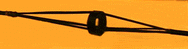
For a rear sight, a peep sight which is installed in
the bow string is the common solution to
shooting well without a lot of practice.
For hunting you should use the largest peep, at least 1/4" in diameter, to
let in the most light. The bow string strands are separated so that
equal numbers of strands traverse each side of the peep, the peep is
adjusted in height to fit your eye, and then serving (strong thread) is
wrapped around the string above and
below the peep to hold it in place. There are two types of
peeps. |
 |
 |
One type is inserted into the string with the hole
parallel to the string. This type allows you to
see through the hole only when the bow is drawn. The
second type fits into the string with the hole pointing |
toward the front of the bow. Since the bow
string has a tendency to rotate when the bow is drawn, a rubber band
or tube attached to one of the bow cables is employed to keep the
hole pointed toward the front of the bow.
|
 |
The next important accessory is the arrow rest. You should have
one that lets the arrow pass over or
 |
through it without touching the arrow's fletching
(feathers or plastic vanes). There are many types of arrow
rests that fulfill this requirement. The simplest is the arrow rest with two prongs that hold the arrow in
such a manner that the "cock feather" passes between the prongs.
The cock feather is the different color feather or vane. If
you use this type of arrow rest be sure the
arrows you purchase have nocks that
are oriented |
right or are adjustable because the usual preassembled
arrows point the cock feather horizontally away from the bow riser, not down.
A disadvantage of this type of arrow rest is that the arrow can be easily
knocked off the rest in drawing the bow.
Either a drop away arrow rest with
a deep "V" (guides the arrow through part of its travel through the bow, but
drops away before the fletching reaches the V) or a Whisker Biscuit arrow rest
works better for hunting. The Whisker Biscuit is a
 |
circular
brush that holds
the arrow securely, but allows the fletching to slip between the
bristles. Both hold the arrow securely, although the Whisker
Biscuit will slow the arrow a little bit relative to the drop away. |
To shoot accurately you need to do
everything exactly the same for each shot. An accessory that can
| help you do
this is a mechanical release. If you let the bow string slip
off from your fingers when shooting, it is hard to be totally
consistent. The mechanical release, or trigger release
mechanizes the release, and just as machines are usually better than
people at doing repetitive operations, the mechanical release will
help you shoot more accurately. |
 |
The next accessory is the stabilizer.
It dampens vibration set up in the bow when the string is
 |
released. Shooting
a bow is not much different from plucking a guitar or violin string,
except that the displacement of the string is much greater.
Therefore the shock upon release is much
greater. The stabilizer helps to dissipate that shock. This
helps to silence the bow and makes it more comfortable to shoot.
It also puts weight in front of the bow to help balance the bow in
your hand. |
The
last common major accessory is a quiver for carrying arrows. Most bow
packages come with a quiver that attaches to the bow for carrying.
It mounts on a plastic block that attaches to the
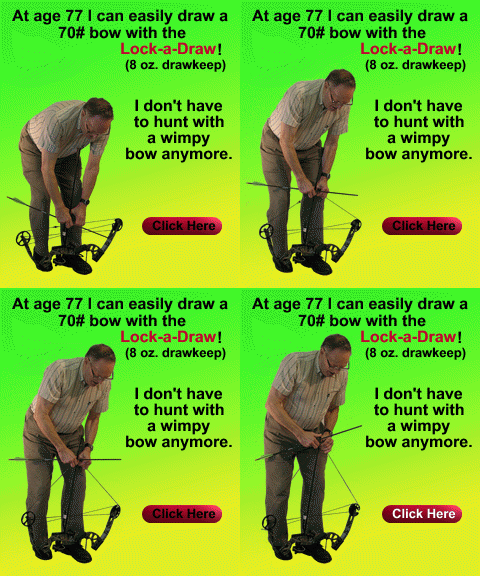
rear of the bow sight. An accessory that allows
people of lesser strength to participate in the sport of archery is the
drawlock. It is a device that attaches to a bow which allows the bow to
be drawn in an unconventional manner using the stronger muscles of the back.
It also maintains the bow at full draw, has a trigger release, and a
safety. In operation it converts the compound bow into a vertical
crossbow, and is an alternative to the crossbow. A number of states
limit the use of a drawlock for hunting to those who have a disability or to
people over 65 years of age, Michigan being one of them, but they are legal in
quite a number of states. A new drawlock product that is a "bowhunting
system" has recently reported that is ideal for bowhunting from a tree stand.
Although not yet available for sale, it is described and demonstrated at
http://www.bowdrawlock.com.
|